
"A book is like a sweater - it must be made in such a way, so it does not unravel"
Weronika Daniluk
"Butenko pinxit" or "painted by Butenko" is a signature that can be found on about two hundred and fifty works by this eminent Warsaw illustrator, representative of the Polish School of Illustration, author of illustrations for many books and the characters of Kwapiszon, Gapiszon, Gucio, and Cezar.
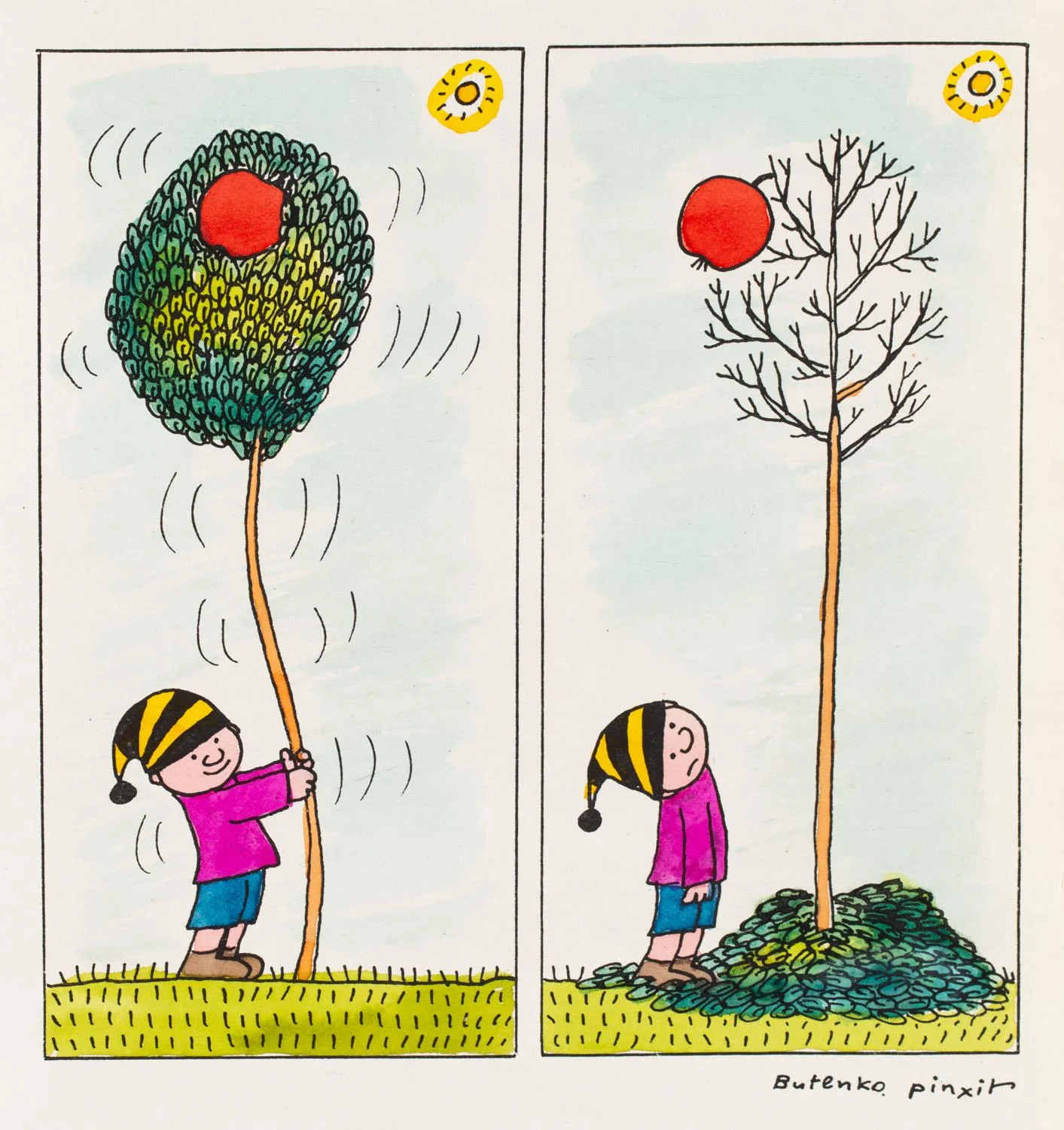
The illustrator graduated from the class of Jan Marcin Szancer in 1955. Although, as he jokingly claims, he derives his artistic origins from Jan Matejko. After all, Mehoffer was a student of Matejko, Szancer of Mehoffer, and eventually, Butenko was Szancer's student... From the very beginning, the artist was associated with book illustration, which had always been the core of his activity. He created illustrations for the book by Nikolai Leskov "The Tale of Cross-eyed Lefty from Tula and the Steel Flea" as part of his diploma at the Academy of Visual Arts in Warsaw (now the Academy of Fine Arts). Immediately after graduation, he began cooperation as an artistic director for the Nasza Księgarnia publishing house, which continued for ten years. In 1965 the first work illustrated by Butenko was published - a children's book by Julian Tuwim titled "Mr. Miniscule and the Whale". The artist collaborated with TVP Polish Television for twenty years. He also went down in history as a designer of puppets and decorations for puppet theaters, as well as a set designer for the Kabaret Starszych Panów cabaret. The set designs of two evening shows (thirteenth and fourteenth) from 1965 are particularly representative of his style.
How did it all start?
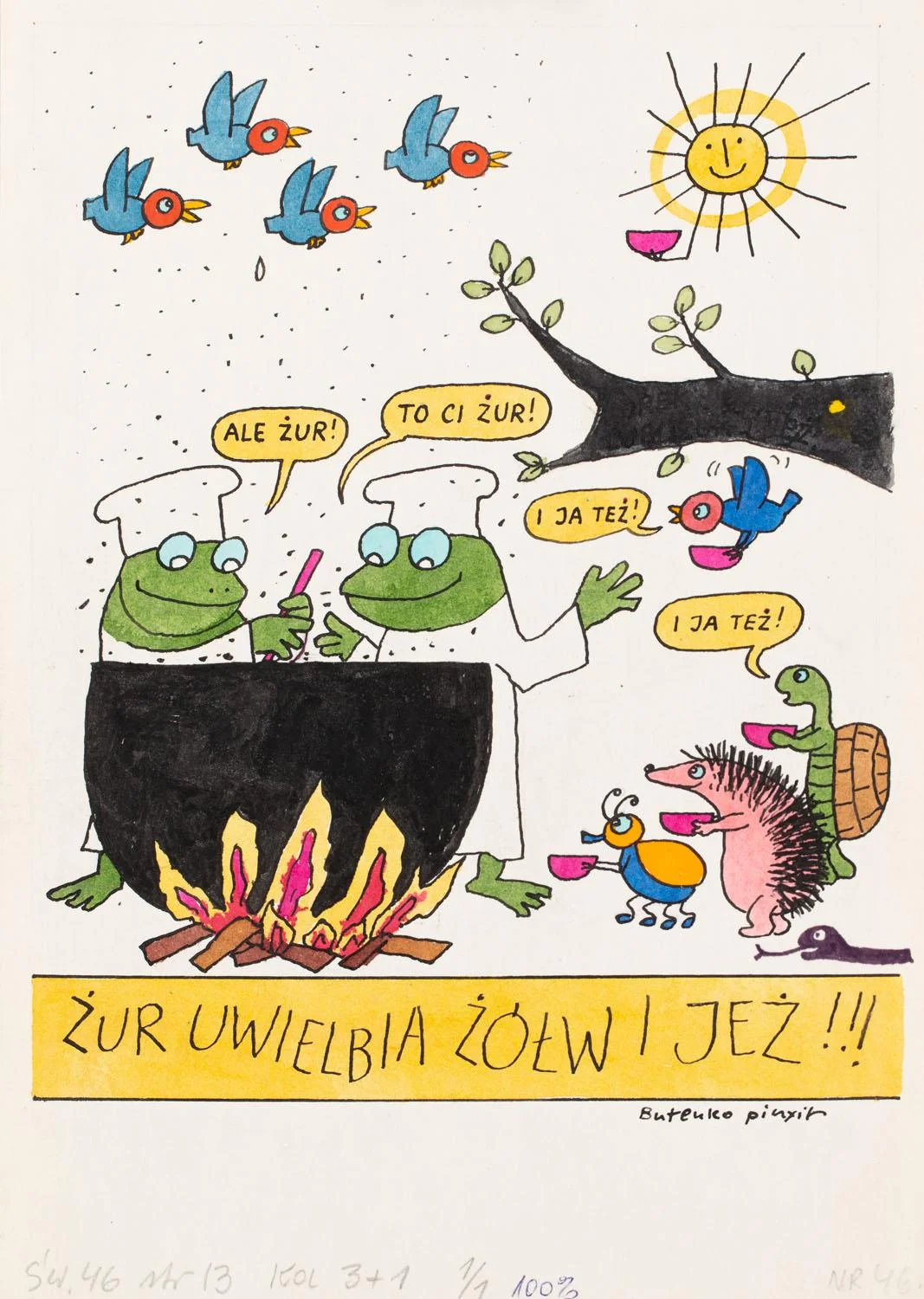
"I started in second grade. […] At that time, I illustrated comics based on my own ideas, which were passed from notebook to notebook, from science to Polish, from Polish to mathematics, and such drawn-out stories, which were based on my own, I repeat, my own ideas, were passed from hand to hand and were very popular among my fellow students, much less among the teachers. Sometimes I received a lower grade, and I even had to rewrite my notebook twice to make it neat. I am not sure if I did not draw something in this rewritten notebook as well."
source: "Bohdan Butenko. Książkę robi się jak.. sweter", Culture.pl https://www.youtube.com/watch?v=rYP2nKhhn8k
Architect of Books
"A book is made like a sweater, meaning that we start with the cover and go through all the pages equally thoroughly, with the same interest and artistic approach."
source: "Bohdan Butenko. Książkę robi się jak.. sweter", Culture.pl https://www.youtube.com/watch?v=rYP2nKhhn8k
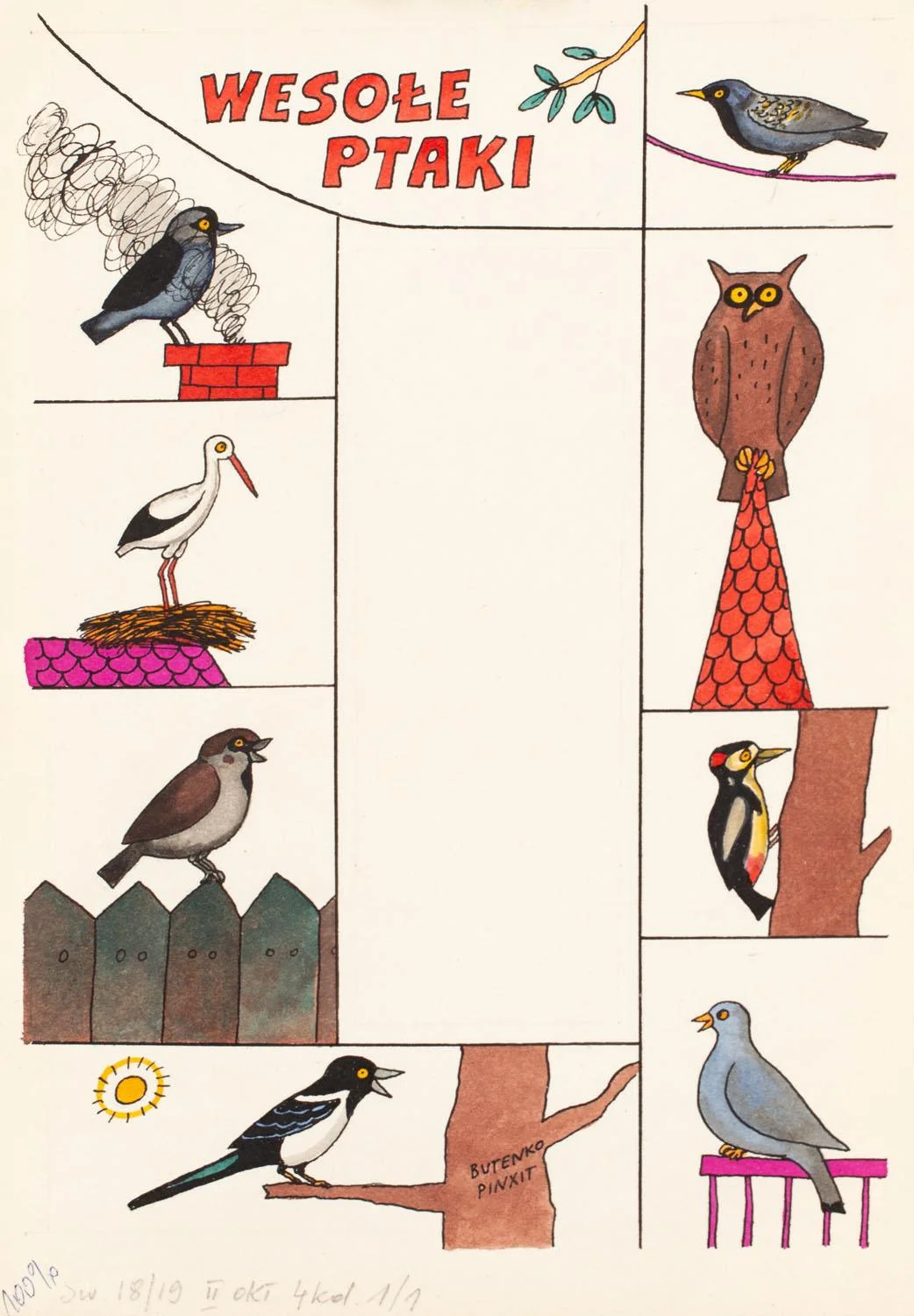
Butenko was called the architect of books as he designed them in a very comprehensive manner. He authored not only illustrations but the entire graphic concepts of books, starting with the cover, the table of contents, through the very illustrations, page numbering, chapter numbering, ending with the font, footnotes, and footer design. As a result, his books constituted a separate, closed microcosm and the reader was drawn into it with every element of the printing. It was the text, however, that was always the most important. The artist was concentrated on it when starting a new project. Butenko recalls that several times, during his work, he came up with a new idea that seemed to be better than the original concept. He was faced with the choice of continuing the project or starting work from scratch. What did he do? The choice was apparent as the nature of the perfectionist did not allow the first option.
"I would not sleep well, thinking that I could have made this book better. So I started all over again."
Artist's Craft
Bohdan Butenko, to the surprise of the publishers, worked in the analog technique until the end, always using a piece of paper as the main medium, not a computer screen. Nonetheless, technology enhanced his work on the series about Kwapiszon's adventures for the Nasza Księgarnia publishing institute. It was the first Polish collage comic book published since the 1970s. The project was aimed at promoting various sites on the map of Poland. The laborious work, as the author says, consisted in manually superimposing the drawings of Kwapiszon on the photographs of various places in Poland. As it was impossible to make corrections on the photographic paper, and the characters had to be perfectly matched, it was an extremely arduous and time-consuming task. The technological advance, which over time made it possible to create collages on a computer, significantly accelerated the work. The process of superimposing drawings on photographs from Poznań took 3 days instead of 1.5 months!
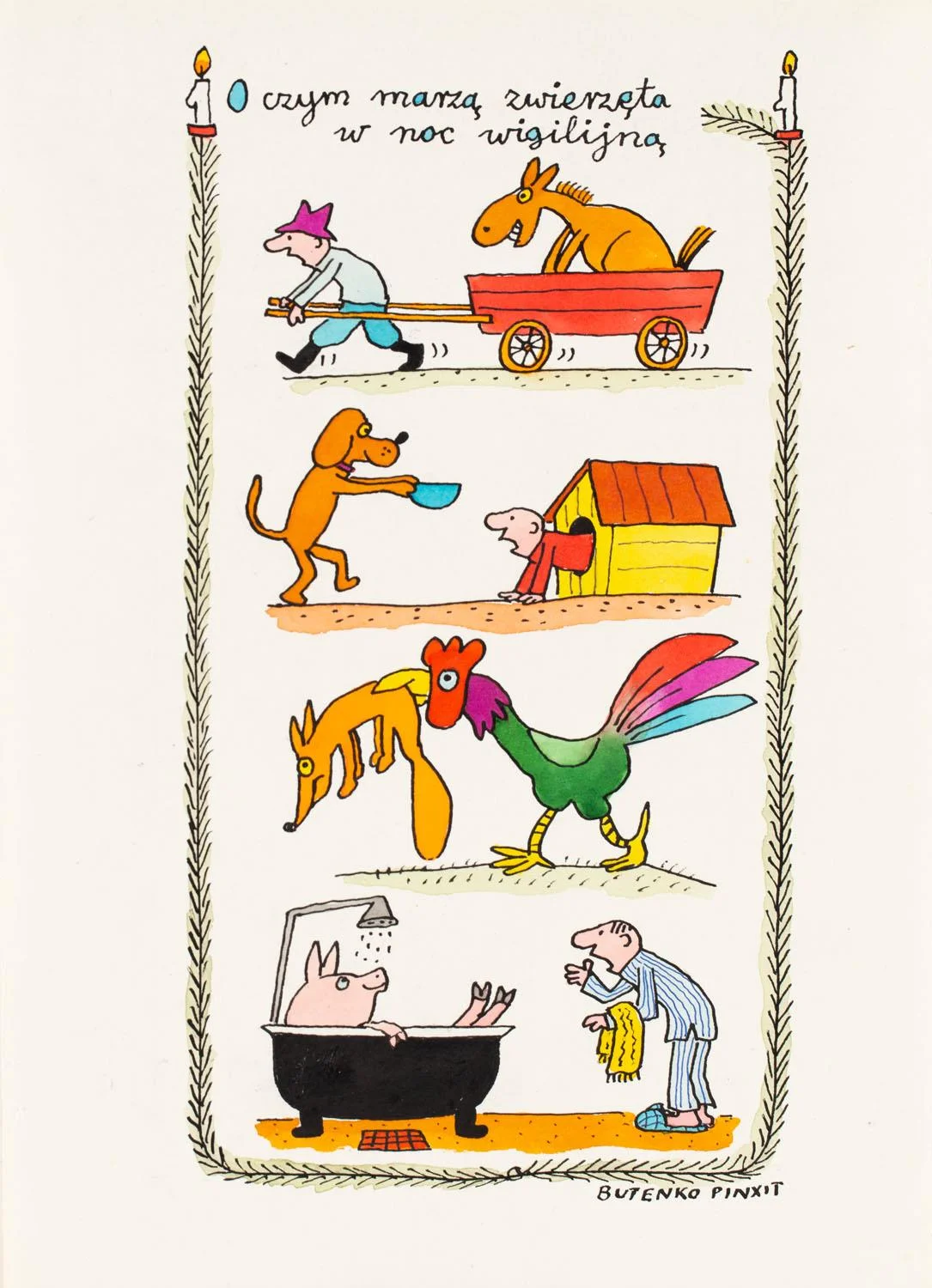
Bohdan Butenko developed a distinctive and unmistakable style. He used flat spots of color and graphic outlines. Over time, his style came closer to the aesthetics of comic books. He reduced the content of his depictions to the very essence. The artist put emphasis on jokes, which were always very smart. In 2013 a monographic exhibition titled "Bohdan Butenko. Book is Made Like Sweater" was organized as part of the Conrad Festival at the Bunkier Sztuki Gallery in Krakow.